

Dependencies in Timeline Pro
Timeline dependencies connect work items by their start or due dates. Use them to see which work must happen first and where scheduled dates conflict.
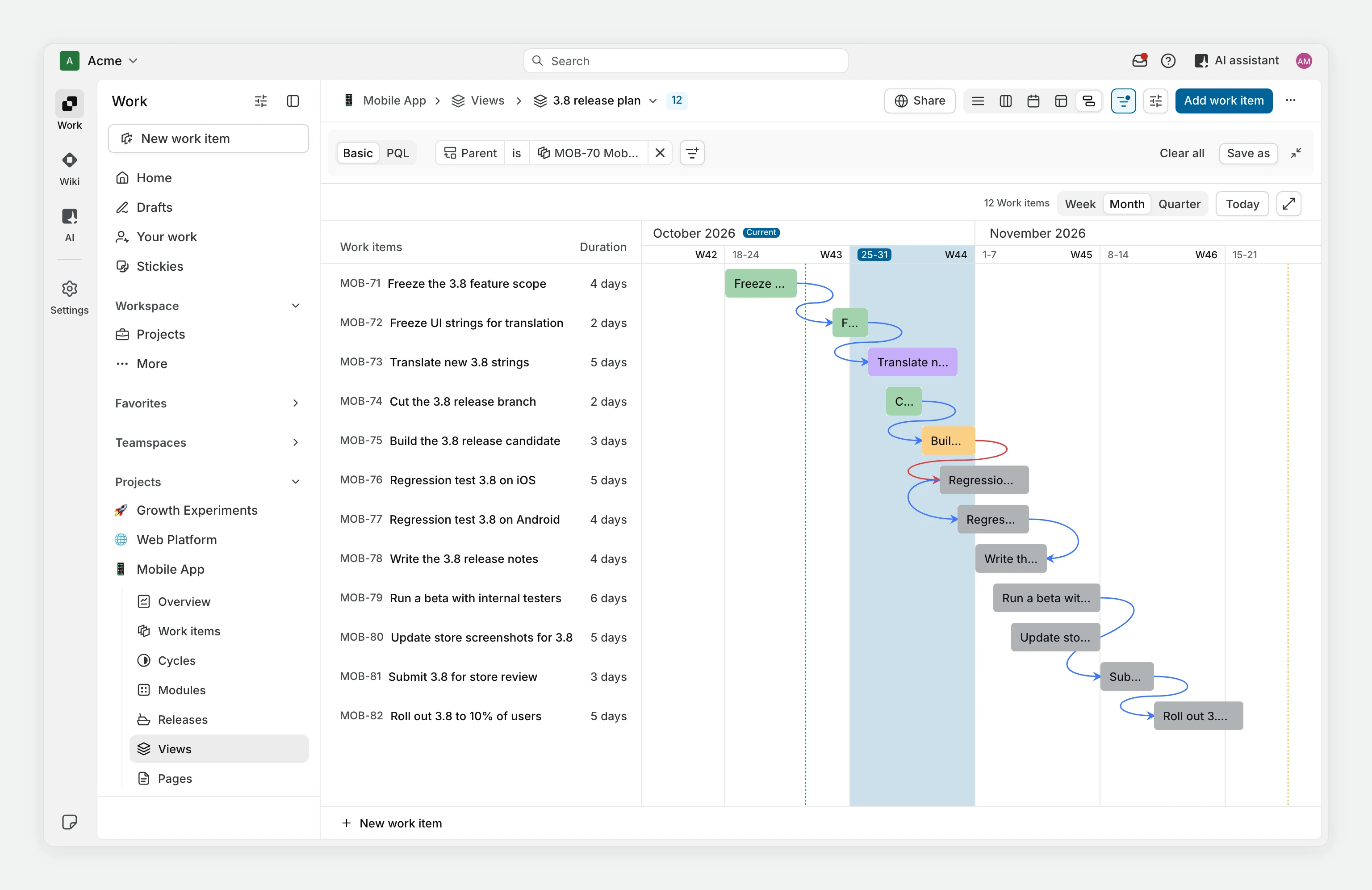
There's no setting to turn dependencies on. If your plan doesn't include them, the timeline shows no connectors or handles, dragging a bar moves only that work item, and Add dependency in a work item offers only Blocked by and Blocking.
Open the timeline
Open one of these and select Timeline Layout in the layout switcher in the header. On a phone, the layout menu calls it Timeline.
- A project's Work items page
- A cycle or a module
- A project view
- A teamspace's work items, its projects' work items, or a teamspace view
- A release, or a milestone's timeline
- A workspace view or All work items, when the Timeline layout is available there
- The Work items tab in an initiative's Scope
The timelines that show modules, projects, or initiatives as bars don't have dependencies.
When a connector appears
Plane draws a connector when both work items are on the timeline and the two ends it connects have dates:
- Finish-to-start: the first work item's Due date and the second work item's Start date.
- Start-to-start: both Start dates.
- Finish-to-finish: both Due dates.
A work item counts as on the timeline when the timeline has loaded it and it isn't hidden by a filter, inside a collapsed group, or an unexpanded sub-work item. The timeline loads work items in pages as you scroll, so a work item further down a long list has no connectors until it loads. Scrolling a bar out of view doesn't hide its connectors.
A work item with no dates has no bar. A work item with only one date shows a short bar starting or ending on that date.
Create a dependency
You need permission to edit work items to create or remove their dependencies. Workspace owners, workspace admins, project admins, and project contributors have it. Commenters and guests don't.
- Hover over a work item's timeline bar to show its connector handles. The left handle appears when the work item has a start date, and the right handle when it has a due date.
- Drag a handle onto the other work item's bar. Drop it on the left half of the bar to connect to that work item's start, or on the right half to connect to its due date.
- Release to create the dependency.
The handles you connect determine the dependency type. For example, drag the first item's right handle to the left half of the second item's bar to make the first item block the second.
If the half you drop on doesn't have the date you need, Plane connects to the date the bar does have. From a right handle, that gives a finish-to-finish dependency when the other bar has no start date, and finish-to-start when it has no due date. A left handle dropped on the right half gives a start-to-start dependency. If the other bar has no start date, Plane creates nothing.
Plane doesn't show a message when it creates a dependency. If it can't save one, the connector disappears. You can't connect a work item to itself, or to a work item it already has a dependency or relation with, such as Relates to or Duplicate of.
You can also open a work item and click Add dependency, the dependency icon in the work item's toolbar. Choose a dependency type, then search for and select one or more work items. See Add dependencies for the detail-view steps.
Dependency types
These dependencies describe date order. Creating a dependency does not change either work item's dates or state.
| Type | Drag from | Drop on | Shows on the work items | The connector turns red when |
|---|---|---|---|---|
| Finish-to-start | First item's right handle | Left half of the second bar | Blocking on the first item; Blocked by on the second | The second item starts on or before the first item's due date. |
| Start-to-start | First item's left handle | Left half of the second bar | Starts Before on the first item; Starts After on the second | The second item starts before the first item's start date. |
| Finish-to-finish | First item's right handle | Right half of the second bar | Finishes Before on the first item; Finishes After on the second | The second item's due date is before the first item's due date. |
A connector is blue when the dates follow the dependency and red when they don't. Its arrow points at the second work item. Connectors update while you drag a bar.
The labels appear in the Dependencies section of each work item. In other layouts, a work item with dependencies shows a count, with the tooltip Dependencies: N.
Set the dates used by the dependency. A finish-to-start dependency needs the first item's Due date and the second item's Start date. Start-to-start dependencies need both start dates, and finish-to-finish dependencies need both due dates.

Adjust dates
Drag a bar to move a work item's schedule, or drag an edge to change its start or due date. Moving a bar needs both dates. If a work item has only one date, dragging the edge for its missing date sets that date. Dates change in whole days, and a bar is at least one day long. You need permission to edit the work item you drag.
If there are free days between two linked dates, the connected bar does not move until your change uses up those days. Plane counts calendar days, including weekends.
When a move or resize would put linked dates out of order, Plane shifts the connected bars only as far as needed to restore the order, and keeps their durations:
- Moving a work item later pushes the work items that depend on it later. Moving the whole bar pushes all of them. Moving its due date later pushes finish-to-start and finish-to-finish successors. Moving its start date later pushes start-to-start successors.
- Moving a work item earlier pushes the work items it depends on earlier. Moving the whole bar pushes all of them. Moving its start date earlier pushes finish-to-start and start-to-start predecessors. Moving its due date earlier pushes finish-to-finish predecessors.
Plane never pulls a work item back to close a gap. If you move a work item earlier, the work items that depend on it keep their dates. The bar you drag never moves because of a push.
Shifts carry through every linked work item, so a chain such as A blocks B blocks C moves together. A work item linked to several others moves as far as the largest push needs. A linked work item that has no dates, or that the timeline hasn't loaded yet, keeps its dates, and the shift doesn't continue past it. If a linked work item has only one date, Plane moves that date.
You see the connected bars move while you drag, and dragging back returns them. Plane saves the new dates of every moved work item when you release the bar, and records each change in the work item's activity. There's no undo. If the save fails, Plane shows Error while updating work item dates, Please try again Later and puts the dates back.
Editing a date in a work item's details does not trigger this adjustment. Plane leaves existing conflicts as they are. When you drag a bar that's already in conflict, the linked bar keeps the same overlap instead of being fixed. If a connector is red, review the linked dates and adjust the schedule to match the dependency.
View and remove a dependency
Click a connector to open Timeline dependency. The dialog shows the two work items with their IDs, titles, and dates, and the dependency type between them, named from the first work item's side: Blocking, Starts Before, or Finishes Before. Nothing in the dialog is editable. Click a work item in the dialog to open it. To change a date, open the work item or move its bar in the timeline.
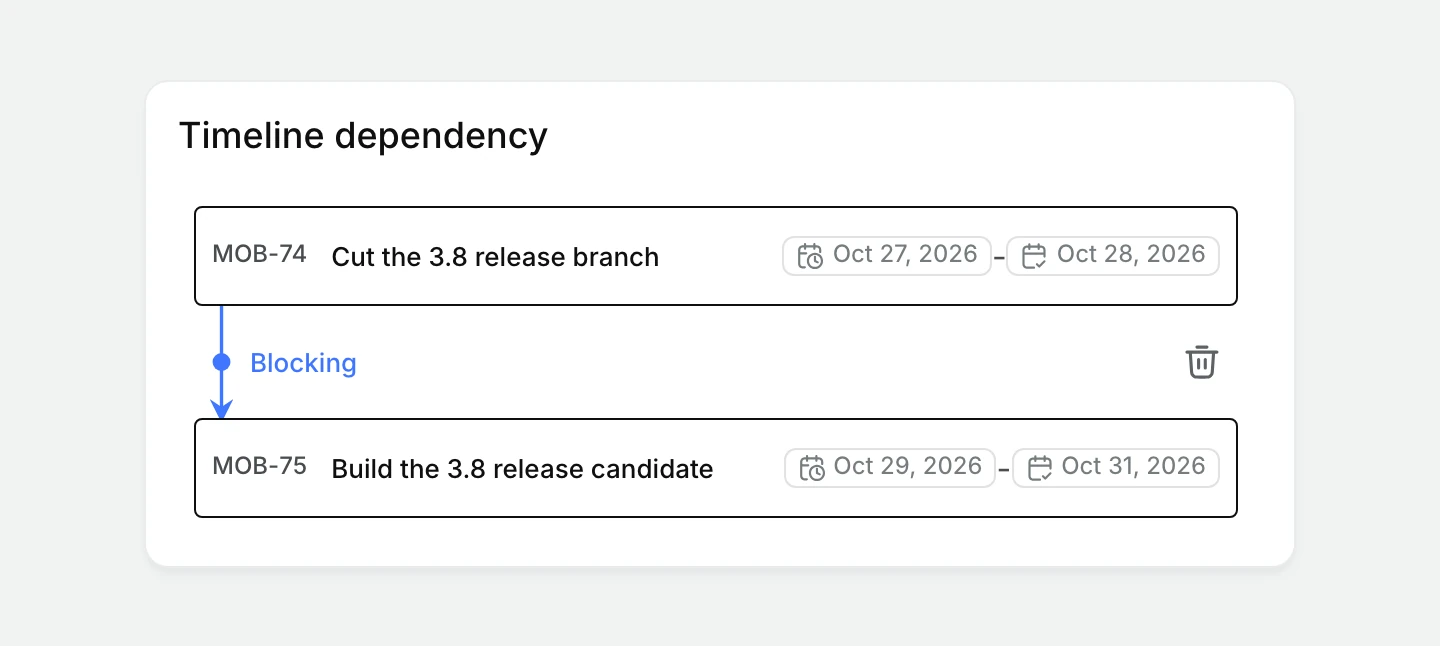
To remove the dependency:
- Click its connector.
- Click the trash icon (Remove dependency).
Plane removes the dependency right away, without a confirmation, and shows Dependency Removed.
Removing a dependency keeps both work items and their dates. Two work items can have only one dependency between them. To change its type, remove the dependency and create a new one.