

Project Updates Pro
Project updates provide a way to share project status and create a timeline of project progress. Use updates to communicate where your project stands, highlight blockers, and keep stakeholders informed without requiring meetings or status check-ins.
Updates are status posts that appear in the Updates tab of your project's side panel on the Overview page. Each update includes a status indicator (On track, At risk, or Off track) and a message describing the current state of the project. Updates appear in chronological order, creating a history of your project's progress over time.
When to use project updates
- Regular status reporting (weekly sprints, monthly milestones)
- Communicating blockers or risks to stakeholders
- Keeping remote or distributed teams aligned
- Creating a historical record of project decisions and progress
- Providing visibility to team members who aren't in daily standups
Turn on project updates
Project updates must be enabled in project settings. Only a project admin can do this.
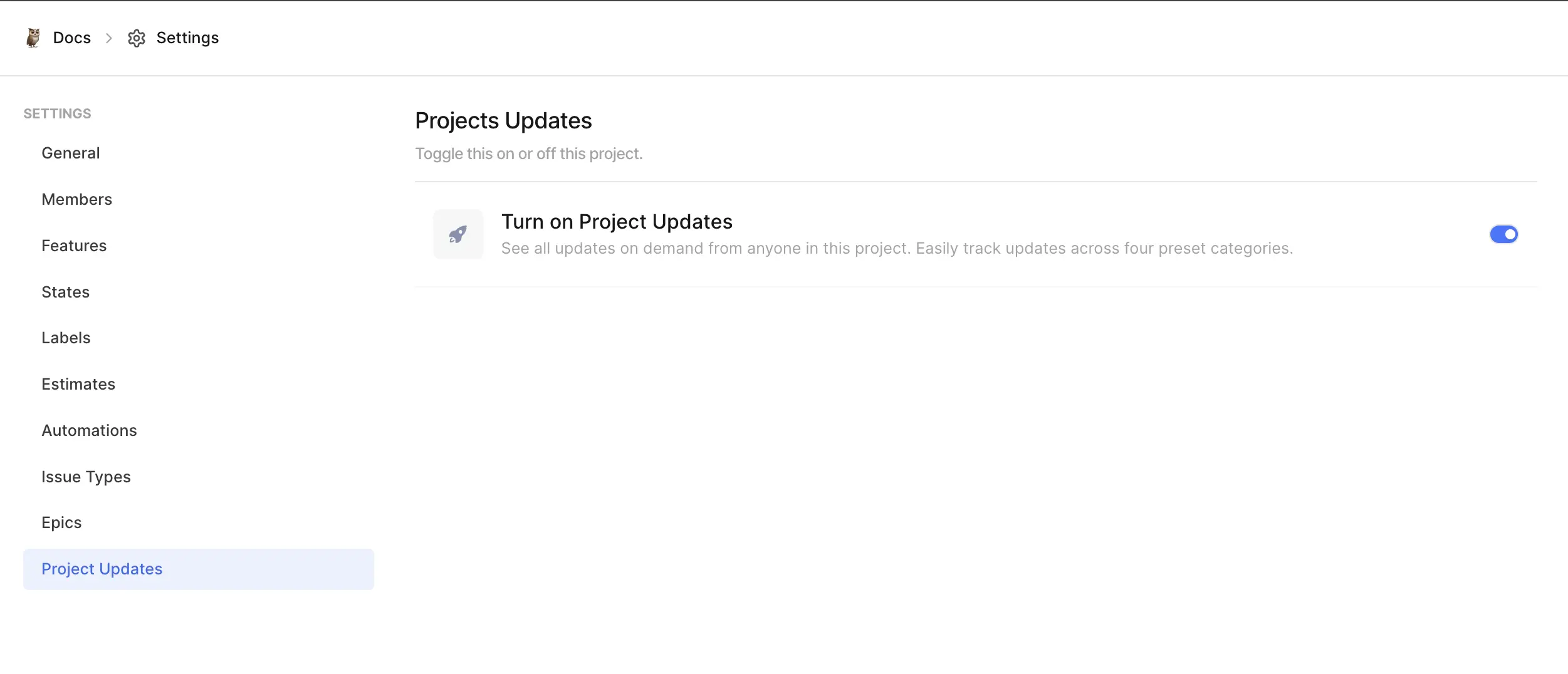
- Navigate to your project.
- Click the … icon next to your project name.
- Select Settings.
- Under Features, go to the Project Updates tab.
- Turn on Enable project updates.
Until updates are on, the Updates tab on the Overview page reads "Feature is disabled, you can enable it in settings" with a Turn on Project Updates button.
Who can post updates
Project admins and contributors can post updates. Contributors can edit and delete only their own. Commenters and guests can read updates and react to them, but can't post.
Add a project update
- Navigate to the Overview page under your project.
- In the side panel, click the Updates tab.
- Click Add update.
- Select your project status from the dropdown.
- Write your update message in the text field. The placeholder reads "Add an update".
- Click Add update.
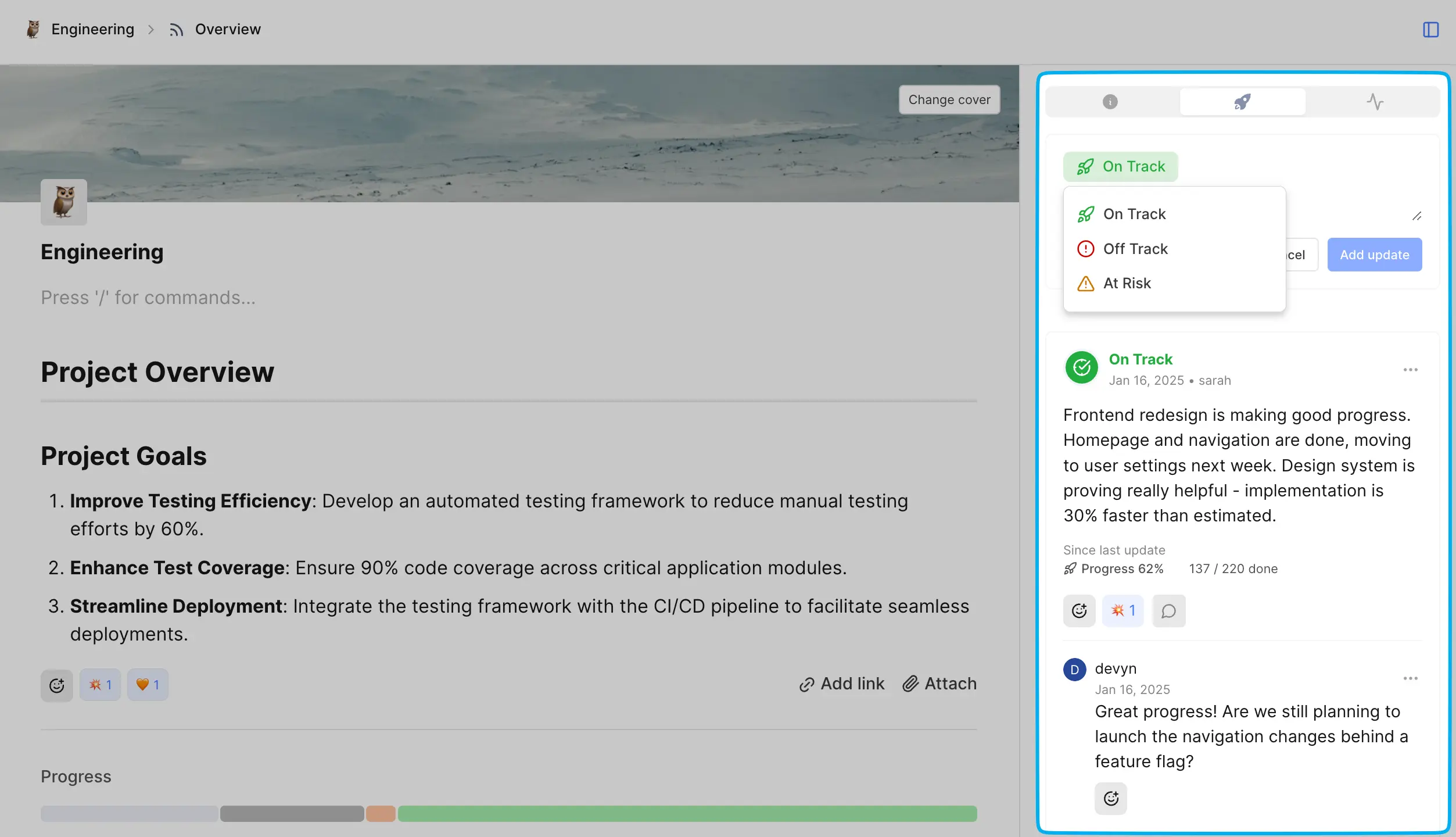
Plane shows "Update created" and your update appears immediately in the updates timeline with a timestamp. The Add update button stays disabled until you've written something. Click Cancel to discard the draft.
Each update also records the project's progress at the time you posted it: {completed}/{total} done and {percentage}% progress.
Project status options
Each update requires a status indicator that signals the project's current state.
| Status | When to use it |
|---|---|
| On track | The project is progressing as planned. Work is moving forward according to schedule, no significant blockers exist, and the team is meeting milestones as expected. Use this status for regular positive progress updates. |
| At risk | The project has potential issues that need attention. There may be emerging blockers, resource concerns, or dependencies that could impact timelines if not addressed. Use this status to flag concerns early and request help before issues become critical. |
| Off track | The project has significant blockers or delays. Critical issues are preventing progress, timelines are at risk, or major decisions are needed to get back on track. Use this status when immediate action or escalation is required. |
Each status has its own icon in the timeline, so a scan down the list shows how the project's health has changed.
Edit or delete an update
- Open the update's menu.
- Click Edit to change the status or message, then Save. Or click Delete.
Deleting asks you to confirm: "Are you sure you want to delete this update? This is an irreversible action." Plane shows "Update deleted".
Collaborate on updates
Project updates support threaded discussions and reactions, allowing team members to engage with status updates directly.
Start discussions
- Add comments in the thread below the update. The placeholder reads "Add a comment".
- Use threads to discuss specific points, ask questions, or provide additional context.
- Threaded discussions keep conversations organized and connected to the relevant update.
- Click Show comments or Hide comments on an update to expand or collapse its thread. The count shows how many comments it has.
Use emoji reactions
- React to updates with emojis for quick feedback.
- Reactions provide lightweight acknowledgment without requiring a full comment.
Project admins and contributors can comment. Contributors can edit and delete only their own comments. Commenters and guests can react to updates and comments but can't comment.
Where updates roll up
When a project belongs to an initiative, the initiative tallies the latest update status of each of its projects, so a lead can see at a glance how many projects are on track, at risk or off track.