

Recurring Work Items Business
Keep your team on track with repetitive tasks by setting them up once and letting them automatically repeat on your schedule.
Recurring work items are templates that automatically create new work items based on a schedule you define. Instead of manually creating the same maintenance check, weekly report, or team standup every time, you set it up once and let Plane handle the repetition.
Think of it like setting a recurring calendar appointment, but for your project work. You define what needs to be done, how often it should happen, and who should do it. Plane then creates these items automatically.
Set up recurring tasks
Project admins and contributors can create recurring work items. If you can't, the page tells you to contact your project admin.
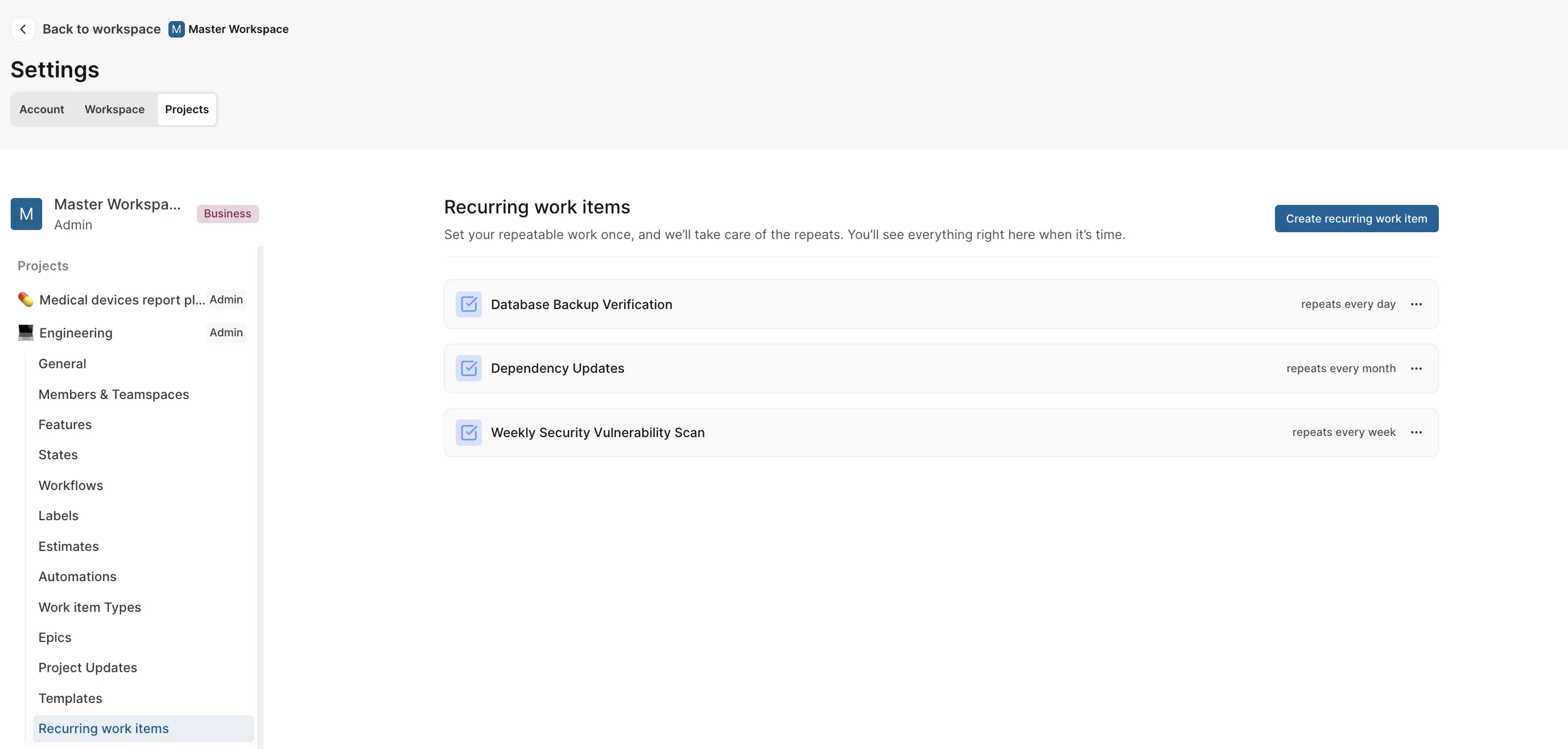
Navigate to your Project Settings.
In the left pane, under Execution, select Recurring work items.
Click Create recurring work item.
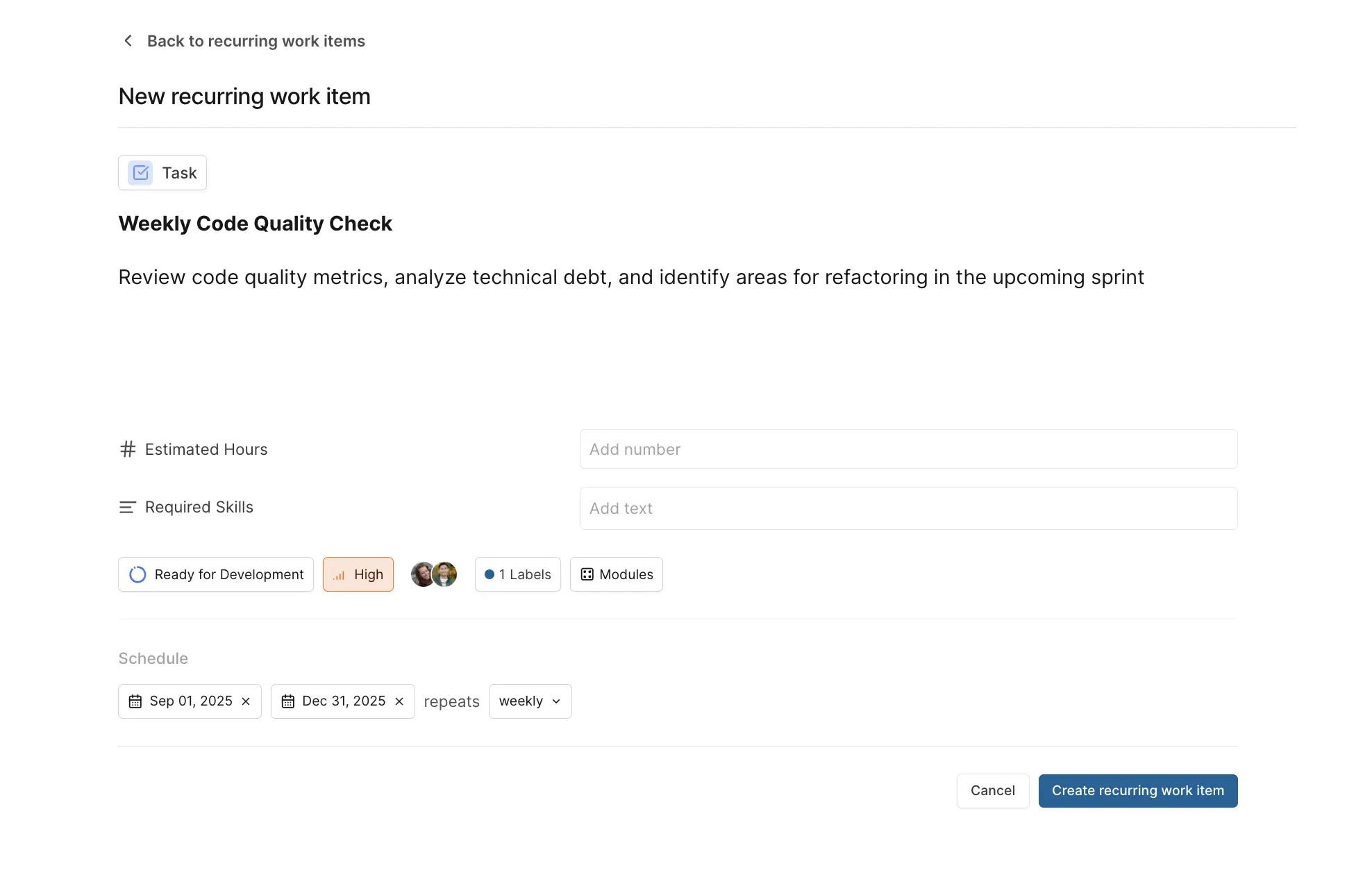
Fill out your recurring work item the way you would any regular work item. Set the work item type, title, description, state, priority, assignees, labels and modules. This becomes your template that gets copied each time a new instance is created.
In the Schedule section, configure when and how often your work item repeats.
- Start date When the recurring pattern begins. Required, and it can't be earlier than today.
- End date Optionally when it should stop. It can't be earlier than the start date. Leave it empty to repeat indefinitely.
- Repeat interval How often Plane creates the next item.
Click Create recurring work item.
Plane shows "Recurring work item created" and schedules the first run.
Repeat interval options
| Option | What it does |
|---|---|
| Daily | Creates the work item every day. |
| Weekly | Creates it every week, on the same weekday as the start date. |
| Monthly | Creates it every month, on the same day of the month. If a month is shorter, Plane uses its last day, so a schedule that starts on the 31st runs on 28 or 29 February and back on 31 March. |
| Yearly | Creates it every year on the same date, with leap years handled. |
| Custom | Every 1 to 30 days, weeks, months or years. |
How the schedule runs
Plane checks for due schedules every 15 minutes and creates each new work item at 00:05 in the project's timezone, whoever set up the schedule. The start and end dates are read in that timezone too: the first run happens at 00:05 on the start date, and the last possible run is on the end date. Set the project timezone on the General tab of project settings. See Set the project timezone.
If you change the project's timezone later, the very next run keeps its already-scheduled time, and runs after that follow the new timezone.
Each new work item is created as the person who set up the schedule, with the template's type, state, labels, properties and estimate. If something in the template no longer fits the project, for example a state that a workflow doesn't allow the creator to use, Plane logs that run as failed, notifies the schedule's owner, and still schedules the next run.
What happens at the end date
Once the end date has passed, Plane stops creating work items. The schedule stays in the list so you can see it, edit it or delete it. It isn't removed.
Manage recurring tasks
All your recurring work items appear in the Recurring work items section of your Project settings. Here you can:
- See all your recurring patterns with their repeat frequency (like "repeats every week").
- Edit the template or schedule for future instances by clicking the three-dot menu.
- Delete recurring patterns you no longer need. Plane asks you to confirm, since deleting removes all data related to the recurring work item and can't be undone.
- Open Activity to see the log of runs, including any that failed.
When you edit a recurring work item, your changes only affect future instances. Work items that have already been created remain unchanged. Plane shows "Recurring work item changed" when it saves.
There's no pause switch. To stop a schedule for a while, set an end date, or delete it and create it again later.
Recurring work items help keep anything from falling through the cracks while reducing the administrative burden on your team. Set them up once, and focus your energy on the work that matters most.